Article
Sputter Coating in Argon Vs Air: Does it Matter?
February 26
July 26

Helena Bland
Application Specialist
A major advantage of Cryo-SEM is that high moisture content samples ranging from gels to pure liquids can be imaged without the need for conventional dehydration methods that compromise structural integrity. In this Knowledge Article, we explore cryo-SEM imaging high moisture content samples using the PP3010 Cryo Preparation System.
The optimal method for imaging liquids, emulsions and gels is by using rivets, as they can securely contain small volumes of liquid. Quorum has a dedicated rivet holder shuttle that accommodates two rivets (PN 20530). The rivets are sealed with Tissue-Tek (OCT compound) and secured with two spring-loaded screws into the rivet holder shuttle (Figure 1).
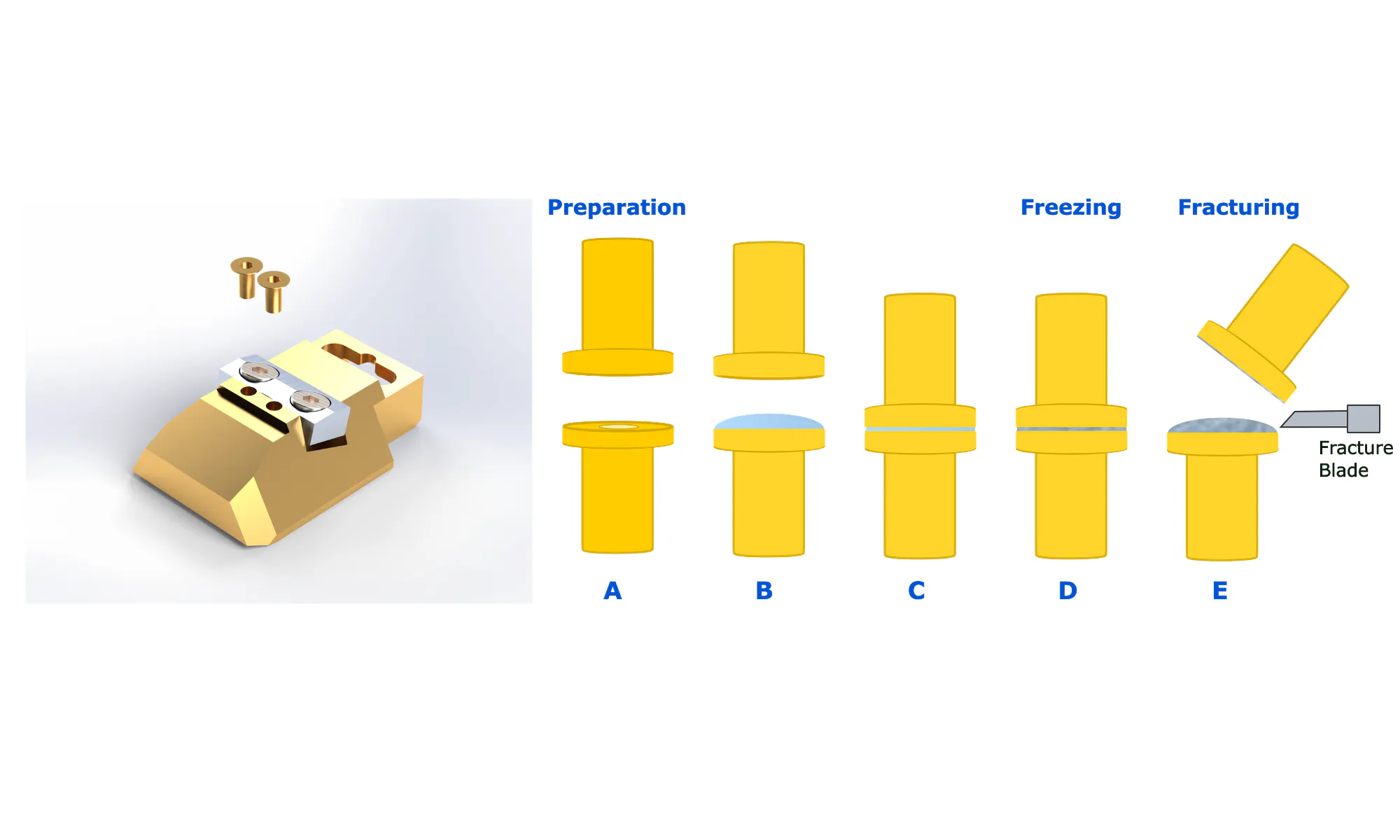
Figure 1. Left: Rivet shuttle (PN 20530) showing rivets being clamped into place. Right: To prepare a liquid sample for fracturing: A) cryo glue (tissue-tek: colloidal graphite 1:1 mixture) is used to secure the first rivet to the shuttle. B) The liquid suspension is drawn into the rivet via capillary action. C) The second rivet is then secured to the first rivet using cryo glue. D) The shuttle is then frozen in slush LN2 and then transferred to the preparation chamber. E) Finally, a cryo fracture blade is used to remove the upper rivet and reveal the frozen liquid sample.[1]
Liquid samples are pipetted into the secured rivet until a meniscus is formed on the surface of the rivet (Figure 1). The tube end of the rivet is then sealed using Tissue-Tek, inverted and carefully placed on top of the first rivet. The second rivet should be held in place via capillary action. The transfer pot is used to transfer the shuttle to the Prep-dek® where it is frozen in slush liquid nitrogen. After freezing, the shuttle is transferred to the PP3010 preparation chamber where the second rivet can be removed using a fracture blade to produce a clean fracture and reveal internal structure. For a detailed overview of the PP3010 workflow, read our application note: https://www.quorumtech.com/application-notes/introduction-to-cryo--scanning-electron-microscopy-and-the-pp3010.
An ideal application of the PP3010 Cryo Preparation System using rivets is for the imaging of cells in solution. Figure 2 demonstrates fractured yeast cells in solution. Fracturing will occur along the line of least resistance, so it is possible to image both intact and fractured cells as demonstrated in Figure 2.
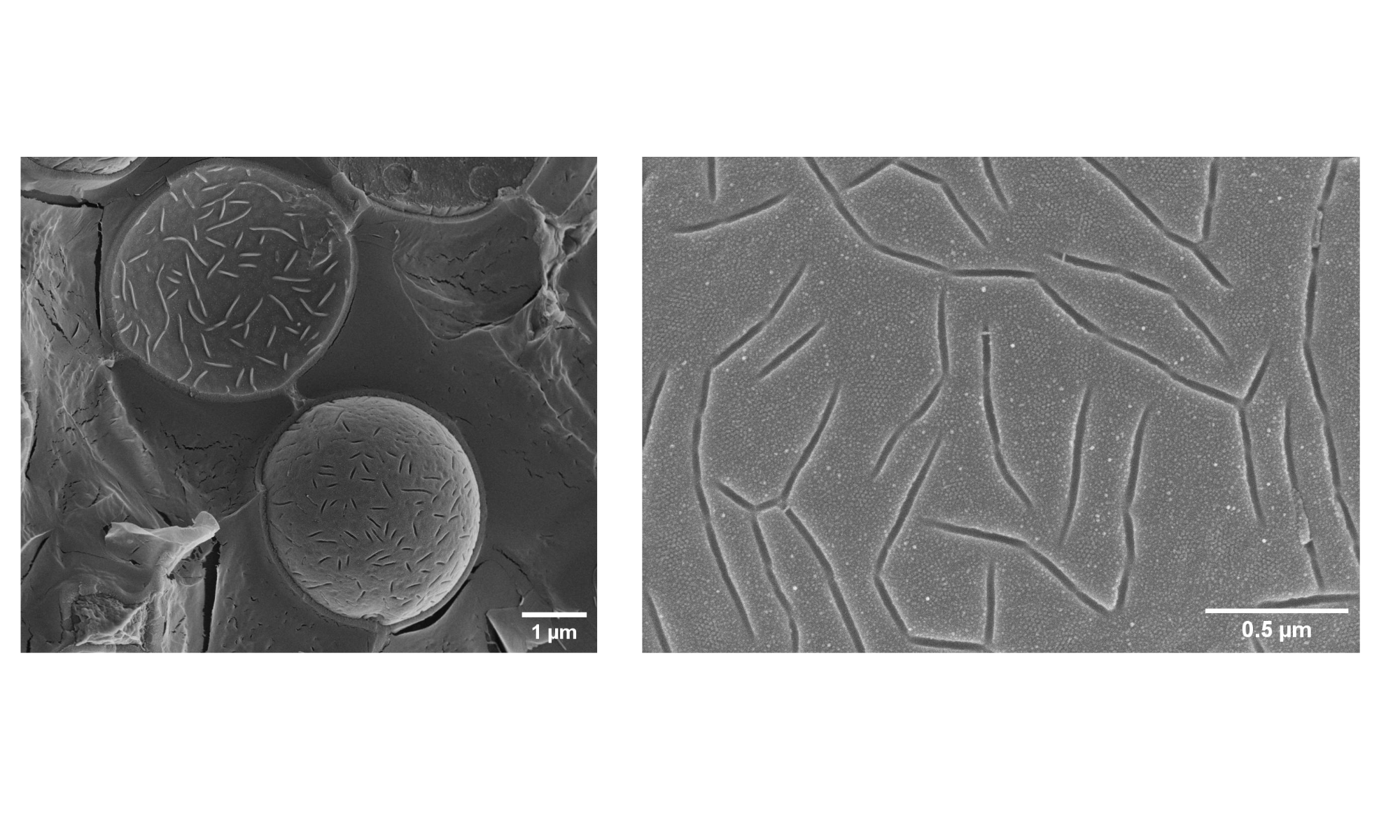
Figure 2. Fractured yeast cells prepared using rivets in the PP3010 cryo preparation system. The method described in Figure 2 was used to freeze fracture the slush LN2 frozen yeast solution. The SEM stage and preparation stage were set to -160 °C, and after fracturing to remove the top rivet, the sample was coated in 2 nm Pt. Imaged using a Hitachi SU8020.
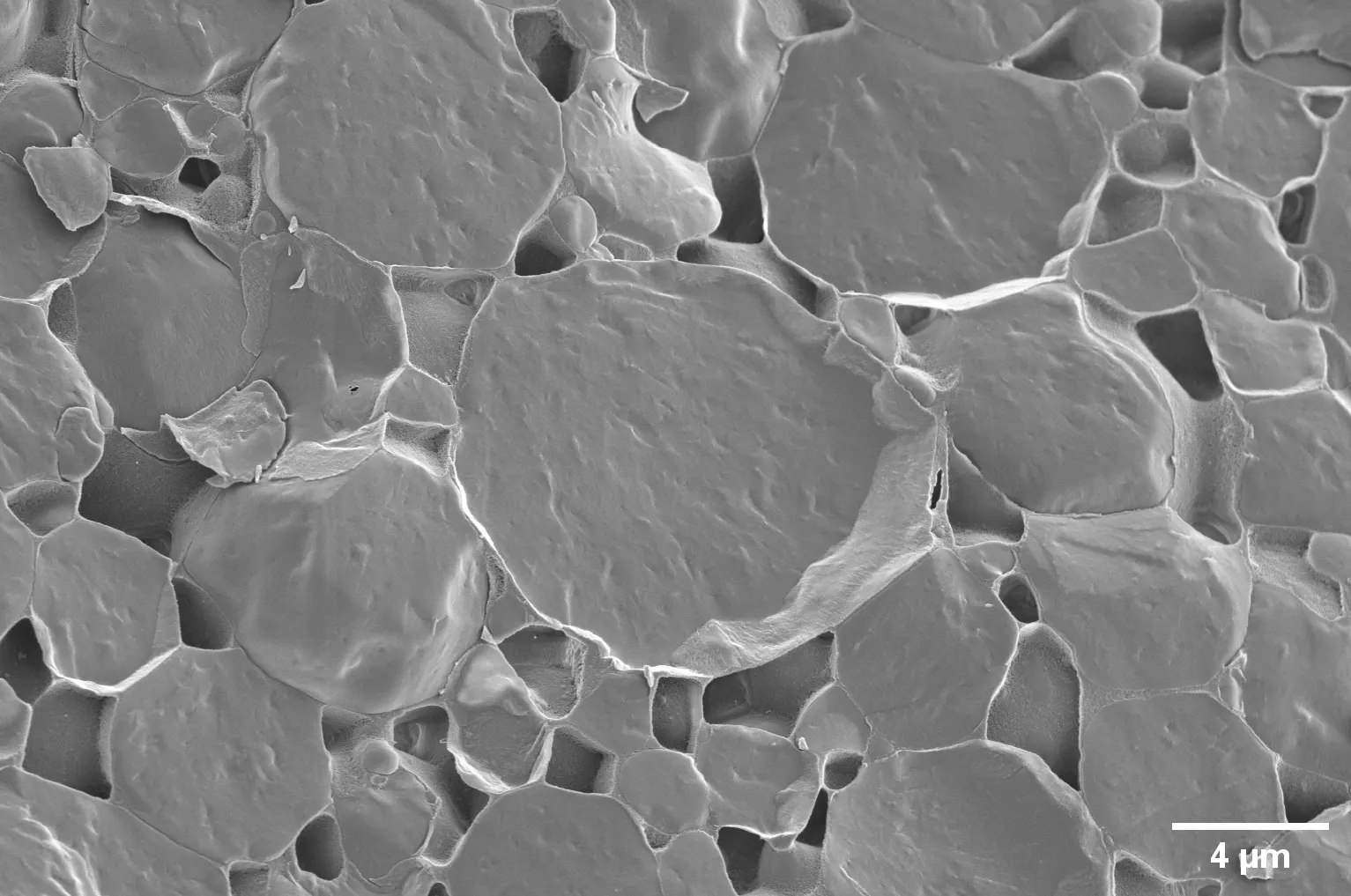
While emulsions and gels can be prepared via mounting onto stubs, the use of rivets offers a few distinct advantages. Rivets can hold a smaller volume of sample compared to standard stubs, enabling more rapid freezing and structural preservation of the sample. Furthermore, fracturing the sample within the rivet typically provides a cleaner, flatter fracture surface compared to fracturing with the blade directly across the sample. Figure 3 shows fractured mayonnaise prepared using rivets on the PP3010 Cryo Preparation System.
Figure 3. Mayonnaise globular fat network prepared using rivets in the PP3010 cryo preparation system. The method described in Figure 2 was used to freeze fracture the slush LN2 frozen mayonnaise sample. The SEM stage and preparation stage were set to -150 °C, and after fracturing to remove the top rivet, the sample was coated with Ir (10 mA, 15 seconds). Imaged using a Thermo Fisher Scientific Apreo ChemiSEM.
References
Hayles, M. F., & DE Winter, D. A. M. (2021). An introduction to cryo-FIB-SEM cross-sectioning of frozen, hydrated Life Science samples. Journal of microscopy, 281(2), 138–156.